Complete Music Reading Trainer vs StaffReader (2026)
A Complete Music Reading Trainer alternative for true beginners. CMRT is deep but overwhelming; StaffReader is the one-note-at-a-time on-ramp before it.


If you opened Complete Music Reading Trainer, saw 270 drills across 7 clefs, and quietly closed it again, you are not the problem — the starting point is. The honest answer to "what is a good Complete Music Reading Trainer alternative" depends on where you are. If you can already read a little and want a deep, no-subscription curriculum, CMRT is genuinely excellent — keep it. If you're starting from zero and that wall of content made you quit, you want a gentler on-ramp first. StaffReader is that on-ramp — one note at a time — and you can graduate to CMRT later.
Disclosure: I built StaffReader. I've tried to be fair to CMRT, including where it beats my app. You should know that going in.
What is Complete Music Reading Trainer, and is it any good?
Short answer: yes, it's good. CMRT (by Binary Guilt Software) is one of the deepest note-reading apps on the App Store. It carries a 4.3-star rating from ~56 ratings on the US App Store (App Store, verify current) — a solid score on a thin review count. The free download unlocks a limited set of exercises; the main curriculum requires a $5.99 one-time purchase. There are also optional Cloud Sync tiers at $0.99 and $9.99 if you want cross-device access and a web interface.
The curriculum is genuinely broad: treble clef, bass clef, alto clef, tenor clef, soprano clef, mezzo-soprano clef, and baritone clef. Key signatures, mixed-clef drills, and an arcade mode alongside the core note-identification curriculum. Four input methods: a note circle, an on-screen piano keyboard, MIDI controller input, and microphone input from a real instrument. If you're a music student who needs to read across multiple clefs and you already own a MIDI keyboard or piano, CMRT is one of the few apps that will actually get you there.
That depth is a real achievement, with no subscription bleeding you monthly. For a committed learner who wants depth and is willing to climb, it's genuinely impressive and a fair value.
So this is not a "CMRT is bad" article. The question is narrower: is all of that the right thing to hand a beginner on day one?
Why does Complete Music Reading Trainer feel overwhelming for beginners?
Because breadth and beginner-friendliness pull in opposite directions, and CMRT picks breadth.
When you have never read music, 7 clefs is not 7 options — it's 7 sources of anxiety, and 270 drills just tells you how far you are from done. The app isn't doing anything wrong; it's built to cover everything, and "everything" is what overwhelms someone who can't yet name a single note on sight.
The settings menu that precedes your first drill is substantial. That's the nature of an app this comprehensive — before it can help you, it needs to know which clef, which range, which exercise type, which input mode. For someone with some theory background and clear goals, that configuration step is quick and reasonable. For someone who isn't sure where to start, it's an early signal that the app expects you to already know what you're doing.
Here's the mechanism underneath the feeling. Skilled readers don't decode notes one letter at a time — they recognize patterns and intervals as chunks, the way you read the word "the" as one shape instead of three letters (Sloboda, 1977; Chase & Simon, 1973, on chunking in chess experts). A beginner has no chunks yet. Drop them into wide, varied content and there's nothing for the eye to latch onto, so they fall back on slow lookup for every note. Reading can be accurate and still painfully slow when recognition isn't automatic — non-automatic decoding eats all your attention (LaBerge & Samuels, 1974). That's the "I practiced and got nowhere" feeling. It isn't a willpower failure; it's what variety-first practice does to a brain with no anchors.
CMRT assumes you already have a foothold. For many users that's fair; for the adult restarting from zero, it isn't.
To be fair: CMRT does have positive reviews from beginners, including a 76-year-old who spent most of his time inside Chapter 1 and progressed steadily there. The progressive-chapter structure works if you can pick a starting chapter and stay in it. The on-ramp gap is for the returning beginner who already quit once — the person who needs the progression decided for them, not chosen from a settings menu.
How is StaffReader different?
StaffReader makes the opposite bet: depth before breadth.
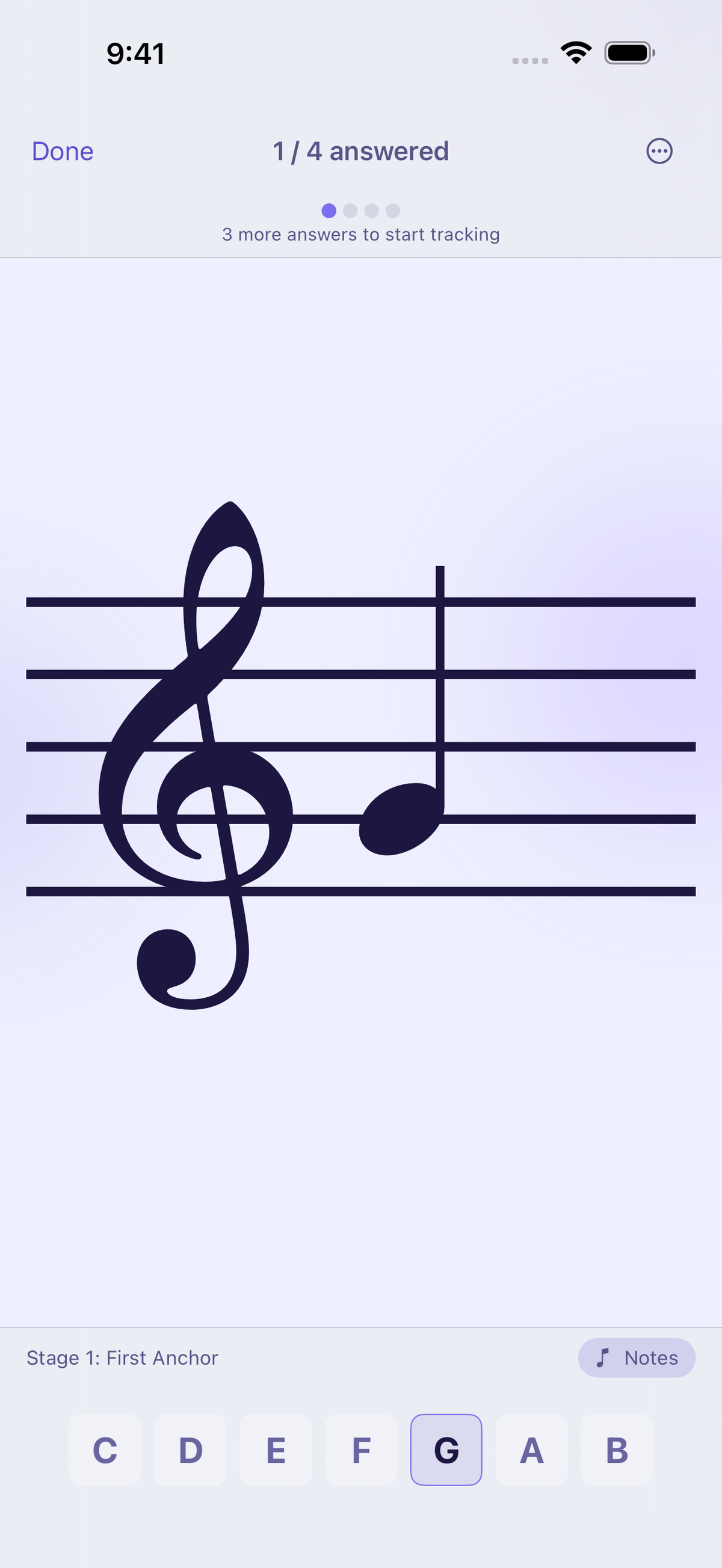
Stage 1 is a single note — G4, the note the treble clef literally curls around. You drill it until recognition is fast and automatic, then earn the next note. You advance by hitting 90% accuracy, not by waiting out a timer. The 90% gate is borrowed from mastery learning — lock in one step before building the next on top of it (Bloom; Kulik et al.). It's a deliberate design choice, not a music-specific magic threshold, and it stops you from stacking new notes on a shaky foundation.
The method itself is the landmark approach, which good teachers have used for decades. You memorize a couple of visually unmistakable anchors — on the treble clef, G4 and C5 — and read every other note by its distance from the nearest anchor. A4 is one step above G4; B4 is one step below C5. You stop counting up from the bottom of the staff and navigate from points you already own. This is the same intervallic reading fluent readers use; the honest caveat is that the evidence is theory-aligned, not proven by one decisive study.
One more honest note: StaffReader uses focused drilling too. The difference isn't "drills bad" — it's what gets drilled and in what order: one anchor to automaticity before the next, not the full range at random.
Side-by-side: CMRT vs StaffReader
| Complete Music Reading Trainer | StaffReader | |
|---|---|---|
| Best for | Students, returning intermediates, parents supplementing lessons | Absolute beginners; adults who tried and quit |
| Scope | ~270 drills, 7 clefs, 26 chapters | Treble and bass clef, one note added at a time (15 treble stages, plus a separate bass track) |
| Starting point | Broad curriculum across many clefs | A single note (G4), then earn the next |
| Advancement | Work through chapters | 90% accuracy gate per stage |
| Price | Free download + $5.99 one-time unlock (App Store, verify) | Free Stages 1–3; $4.99 one-time for the full curriculum |
| Rating | ~4.3 stars, ~56 ratings (US, verify current) | New app, fewer reviews |
| Platforms | iOS + Android | iOS only |
| Plays your real instrument | Yes (input methods incl. mic + MIDI) | No — on-screen only |
A few rows are clear wins for CMRT, and I won't pretend otherwise: it's cross-platform, covers far more ground, and lets you answer on an actual instrument. If those matter to you, CMRT is the better buy.
Use CMRT if… / Use StaffReader if…
| Use CMRT if you... | Use StaffReader if you... |
|---|---|
| Have some theory background already | Are starting from zero, or returning after giving up |
| Need alto, tenor, soprano, mezzo-soprano, or baritone clef | Need treble or bass clef — StaffReader covers those two and no others |
| Want rhythm and key signature drills | Want pure note-reading focus for now |
| Want MIDI or mic input from your instrument | Want to practice without an instrument nearby |
| Are a music student with structured goals | Are an adult learning on your own and need the progression decided for you |
Is StaffReader the right Complete Music Reading Trainer alternative for you?
Think of it as a sequence, not a rivalry:
- Start with StaffReader if you're a true beginner, or you've bounced off note-reading apps before and ended up guessing instead of recognizing. You can try it before paying anything and see whether one-note-at-a-time clicks.
- Go to CMRT when treble and bass feel automatic and you're ready for breadth — the alto, tenor, soprano, mezzo-soprano, and baritone clefs, rhythm, key signatures, intervals, and practice on your real instrument. That's depth StaffReader doesn't provide.
The reason I built StaffReader is personal: I tried to brute-force note reading with mnemonics, practiced daily for a week, and tested at roughly 6% accuracy. The problem wasn't effort — it was being handed too much at once with no anchor to build from. Mnemonics and broad drills aren't useless; they're a useful crutch with a ceiling. What finally worked was narrowing the start to one note and refusing to move on until it was solid.
If that's you: start narrow, get fluent, then let CMRT take you the rest of the way.
Try StaffReader free — Stages 1–3, then $4.99 one-time for the full curriculum:
StaffReader is on the App Store now. Download StaffReader: Learn Sheet Music — the free stages are enough to tell you whether the on-ramp works for you before you take on CMRT's full curriculum.
Related reading:
- Best Note Reading Apps 2026 (Honest, Tested) — where CMRT, StaffReader, and the rest land in a full roundup.
- Note Rush Alternative for Adults (No Mic, No Cartoons) — another deep app, sized up for adult beginners.
- Landmark Notes vs Mnemonics — why anchors beat "Every Good Boy" once you want speed.
- What Chess Masters Teach Us About Reading Music — why chunking, not coverage, makes reading fast.
Try Complete Music Reading Trainer:
Complete Music Reading Trainer on the App Store


