The Landmark Note Method: Why Music Tutor Doesn't Work for Beginners
Looking for a Music Tutor alternative? Here's why most note-reading apps fail beginners — and how the landmark note method fixes it.

The Landmark Note Method: Why Music Tutor Doesn't Work for Beginners
You downloaded Music Tutor. You opened it. The first screen asked you to identify a note sitting two ledger lines above the staff.
You closed the app within a week.
If that sounds familiar, you're not lazy and you're not bad at music. You were handed a tool built for people who already know what you're trying to learn. That's the gap most beginners fall into, and it's the reason so many adults end up searching for a music tutor alternative within days of installing the original.
The wide-range-on-day-one problem
Music Tutor is a genuinely well-made app — it's rated above four stars across thousands of reviews, and it does what it's designed to do well. What it's designed to do is drill. It supports a wide note range by default: up to four ledger lines above and below both the treble and bass staves. Experienced readers benefit from that breadth. Beginners are buried by it.
You can narrow the range manually in settings. But beginners don't know to do that, and the app has no built-in staged progression that does it for them. There's no concept of "introduce one note at a time" baked into the experience. Some reviewers have noted the default range settings feel off-putting and that most users won't think to adjust them.
For a fluent reader, wide-range random drilling is fine. The notes are already automatic, and variety just sharpens speed.
For a beginner, it goes differently. You have no anchor points. Every note requires the same painful three-step lookup:
- Count up from the bottom line
- Match the position to a letter using a mnemonic
- Say the letter out loud
Do that over and over, get most of them wrong, watch your accuracy score sit at 40%, and your brain quietly concludes that reading music is not for you. The app didn't teach you anything. It tested you on material you hadn't learned yet.
Why random drilling fails the adult brain
Adults learn differently from children. A six-year-old will sit through hundreds of repetitions of the same flashcard and slowly build associations through sheer exposure. Adults won't, and shouldn't have to.
Adult learning works best when:
- New material is introduced a few items at a time
- Each item is practiced to fluency before the next one is added
- Progress is visible and immediate, not deferred for weeks
Random-drill apps violate all three. They introduce a wide range at once, never let you reach fluency on any single note, and give you a percentage score that doesn't actually improve. The result is the same every time: a few days of effort, no felt progress, uninstall.
What the landmark note method does differently
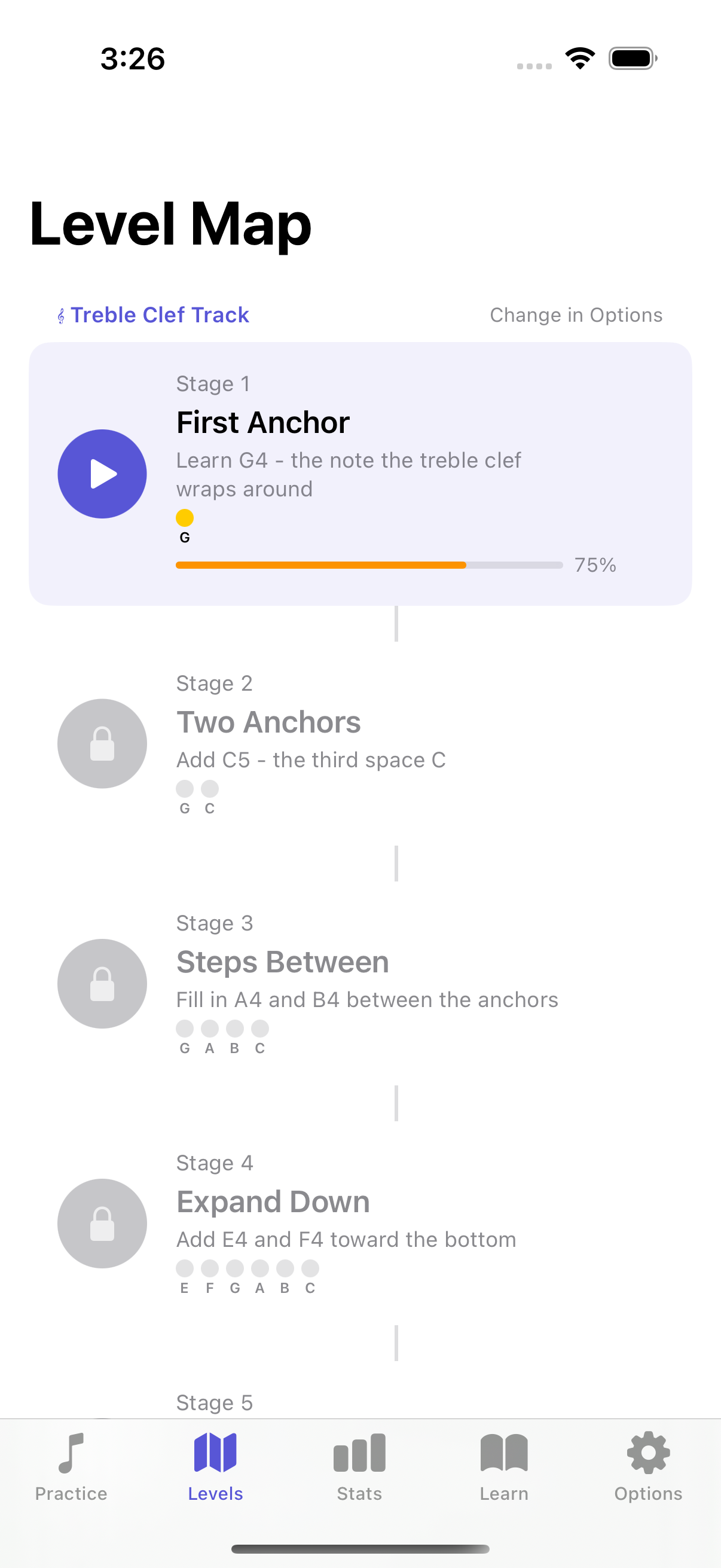
The landmark note method takes the opposite approach. Instead of drilling the full staff from day one, it starts with a single anchor note.
That note is G4 — treble G, the note on the second line from the bottom of the treble staff. It's the note the treble clef curls its spiral around. The clef is literally a pointer at G4, which means you already have a visual anchor before you've memorized a single thing.
Once G4 is automatic — meaning you see it and instantly know what it is, no counting, no mnemonic — a second landmark is added: C5, the third space of the treble staff, one octave above middle C. These two notes frame the heart of the treble clef for beginner readers.
With both landmarks automatic, every other note on the staff can be identified by its distance from whichever anchor is nearest. A note one step above G4? That's A4. One step below C5? That's B4. You stop counting from the bottom of the staff and start measuring from a point you already know. The distance is always small. The lookup is always fast.
This is how fluent readers actually read. They don't recite mnemonics. They anchor and step.
Why this method works for the adult learner
The landmark approach respects how adult learning actually works:
One note at a time. You start with G4. One note — not the entire staff. You drill it until it's reflexive, which usually takes a single short session.
Fluency before expansion. Only after G4 is automatic does the method add C5. Only after both landmarks are solid do neighbors get introduced — A4 and B4 (the notes between the two anchors), then F4 and E4 below G4, then D5 and E5 above C5, and so on. The staff fills in gradually, each new note anchored to points you already own.
Visible progress. Because the curriculum is staged, you can feel yourself getting better. Stage 1 done. Stage 2 done. The sense of completion is what keeps you opening the app on day five, day twelve, day thirty.
Compare that to staring at a 40% accuracy score that hasn't moved in a week.
What a good Music Tutor alternative actually looks like
If you're looking for a beginner-friendly note reading app, here's what to look for — and what to avoid.
Avoid apps that:
- Drop you into the full note range on day one
- Track only accuracy, not progression through stages
- Treat all notes as equally difficult
- Have no concept of "introducing" a new note
Look for apps that:
- Start with a small set of landmark notes
- Add new notes only after old ones are fluent
- Show you a clear curriculum you're progressing through
- Use short sessions (under five minutes) so you actually do them
The best note reading app for an adult beginner is the one you'll still be using in three weeks. Stage-based progression is what makes that possible. Random drilling is what kills it.
Some Music Tutor reviewers make this point themselves — that leaning on mnemonics like "Every Good Boy Does Fine" is an inefficient crutch rather than a path to fluency. That's consistent with what the landmark approach addresses.
A short history of why this matters
The landmark note method isn't new. It's been used by piano teachers for decades, particularly with adult beginners and students who tried traditional methods and stalled. Books like Piano Adventures and the Faber series have used variations of it for years.
What's new is that almost no apps implement it. The App Store is full of flashcard drills built on the assumption that you already know what you're trying to learn. That assumption is wrong for the entire beginner market — which is the largest segment of people downloading note-reading apps in the first place.
That mismatch is the opportunity. It's also the reason a music tutor alternative built around staged, landmark-based learning consistently produces students who actually stick with it past week one.
How to know if the method is working
You'll know within a single session. If the first screen shows you one note — not the full staff — and asks you to learn it, you're in the right place. If you finish a five-minute session feeling like you actually retained something, you're in the right place.
If you finish feeling like you just failed a pop quiz on material you weren't taught, look for an app that respects how learning actually works.
The notes on a staff aren't hard. The teaching method is what makes or breaks the experience.
Ready to try it?
StaffReader is built around the landmark note method, with staged progression that introduces notes only after the previous ones are fluent. It's launching soon on the App Store.
