8 Ways to Learn to Read Sheet Music, Ranked Honestly
How to learn to read sheet music: 8 popular methods compared honestly — mnemonics, flashcards, intervallic, Suzuki, solfège and more, with real strengths and limits.


How to learn to read sheet music, in short: start with a few anchor notes (in the treble clef, G4 and C5), then read every other note by its distance from the nearest anchor — that is the landmark method, and it matches how skilled readers actually read. Drill it daily in short sessions, hold yourself to a high accuracy bar before adding harder notes, and once you can read a little, read a lot of easy music to build pattern recognition. The fuller comparison below explains why that beats the way most of us were first taught.
If you're trying to figure out how to learn to read sheet music, the problem isn't a shortage of methods. It's that every method's biggest fans tell you theirs is the one true path. This post does the opposite: it lays out eight common approaches side by side and tells you, honestly, what each one is good at and where it falls short. Most of them work for something, but they aren't all aiming at the same goal — and a few of the most popular ones quietly stall you right when you think you're making progress.
The goal that actually matters is fluency: seeing a note and knowing it instantly, the way you read a word without spelling it out. Plenty of methods get you to accurate without getting you to automatic, and that gap is where most adults quit. Keep that distinction in mind — it's what separates a method that teaches a test from one that teaches reading.
Disclosure: I built StaffReader, the app behind the landmark method in this post. I hit 6% accuracy after a week of daily practice with a mnemonic-based flashcard app before I understood the method was the problem, not the effort. I've tried to rank all eight methods, including my own, as honestly as I can.
How should you compare methods for learning to read sheet music?
Before the rankings, one ground rule. There is no large, definitive study crowning a single "fastest" way to learn to read sheet music. What we do have is a strong consensus on the underlying mechanism: skilled readers don't name notes letter by letter. They recognize patterns and read by the distance between notes — intervals and contours — the same way chess masters see board positions as chunks rather than 32 individual pieces (Sloboda, 1977; Chase & Simon, 1973). The other well-supported idea is automaticity: reading can be accurate yet slow, and slow reading keeps eating your attention until recognition becomes automatic (LaBerge & Samuels, 1974).
So the honest yardstick isn't "which method has the best marketing." It's two questions:
- Does it build direct recognition (see note → know note), or does it teach a lookup step you have to do every time?
- Does it push you toward automaticity — fast, effortless reading — or just toward passing a written quiz?
I'll compare each method against the landmark method as a reference point, because landmark reading is intervallic reading with training wheels: you memorize a few anchor notes and read everything else by its distance from the nearest anchor. (In the treble clef, the two anchors are G4 — the G on the second line, the line the treble clef wraps around — and C5, the C in the third space; you find any other note by counting steps from whichever anchor is closest.) It's the approach StaffReader is built on, and I'll be upfront about that — but the comparison below is meant to be fair to every method, including the ones we don't use.
The 8 methods at a glance
| Method | What it is | Best at | The catch |
|---|---|---|---|
| Mnemonics (EGBDF / FACE) | Sentences to recall line and space letters | Fast to teach; passing written tests | A verbal lookup chain, not recognition — a useful crutch with a ceiling |
| Flashcards / random drill | Quizzing notes at random, spaced over time | Retention, thanks to retrieval + spacing | Random breadth without a mastery gate trains naming, not intervals |
| Middle-C ("middle out") | Start at Middle C, expand outward | Simple, concrete starting point | Stays note-by-note unless paired with interval reading |
| Intervallic reading | Read by distance and contour between notes | Matches how experts actually read | Higher mental load early; payoff compounds later |
| Landmark method | Anchor notes + read by interval from them | Fast direct recognition with low early load | No instrument or ear training in the loop |
| Suzuki (ear-first) | Learn by ear first, reading delayed | Tone, ear, early motivation | Reading is its most-criticized weakness |
| Gordon / audiation | Sound → sing → audiate → then read | "Sound before symbol"; pairs well with reading | Deliberately defers notation; complementary, not a shortcut |
| Solfège (movable-do) | Sing scale-degree syllables | Tonal hearing and singing | Aimed at the ear, not at decoding the staff |
Now the honest breakdown, roughly ordered from "popular but limited" to "what fluency actually requires."
1. Mnemonics (Every Good Boy Does Fine / FACE)
This is how most of us were first taught, and it's the method I personally tried hardest and got burned by — after a week of daily mnemonic practice I was reading at about 6% accuracy at the instrument. Here's the mechanism: a mnemonic gives you a lookup chain. You see a note, recite "Every Good Boy Does Fine," count to the right line, and finally arrive at a letter name. That's several deliberate steps standing between the symbol and the answer.
The Stroop effect — where naming the ink color of a mismatched color word is harder than reading the word — is a useful analogy here: an automatic response beats a multi-step controlled one. (It's an analogy for the cost of indirection, not proof that mnemonics fail.) Mnemonics are genuinely useful for passing a written theory test and for getting unstuck on a single mystery note. They're a useful crutch — they just have a ceiling, because reciting a sentence is not the same as recognizing a note.
Strength: fastest thing to teach; fine as a backup.
Weakness vs landmark: it's recall-by-recitation, not direct recognition — exactly the bottleneck that stalls people at the instrument. More on this in Why 'Every Good Boy Does Fine' Is Slowing You Down and Landmark Notes vs Mnemonics.
2. Flashcards / random drill
Flashcards lean on two of the well-supported ideas in learning science: the testing effect (retrieving an answer beats re-reading it) and spacing (spreading practice out beats cramming). For retention, this is real and worth using.
The honest catch is what most flashcard apps drill: isolated note names, pulled at random from the whole staff. Random breadth feels rigorous but it trains naming, not interval reading, and without a mastery gate it tends to plateau. (Fair disclosure: this same research supports drilling done well — the landmark approach is itself a drill loop. The difference is in what you drill and when you advance, not whether drilling works.) Drilling intervals, with a high accuracy bar before the difficulty climbs, is very different from being quizzed on forty random notes on day one.
Strength: retrieval + spacing genuinely cement memory.
Weakness vs landmark: random full-range drilling with no gate trains naming over recognition. See Accuracy Isn't Fluency.
3. Middle-C ("middle out")
A traditional piano starting point: anchor on Middle C and expand outward note by note. It has a real virtue — one concrete, memorable reference point is easy for a true beginner, and in at least one direct comparison the Middle-C approach actually produced fewer early errors than intervallic reading. So this isn't a weak method; it's a gentle on-ramp.
The limitation is that, on its own, it can keep you counting note-by-note from C rather than reading the shape of a passage. The landmark method is essentially Middle-C's idea generalized: instead of one anchor, you get a few well-placed anchors, and you read by interval from whichever is nearest. You keep the concreteness and add the pattern-reading.
Strength: simple, concrete, low-anxiety start.
Weakness vs landmark: one anchor can lock you into counting unless you layer in interval reading.
4. Intervallic reading
This is what skilled readers actually do: read by the distance and direction between notes rather than identifying each one absolutely. It matches the expert mechanism directly, and it's what lets fluent readers look ahead and anticipate the next handful of notes (Sloboda, 1974). If there's a "correct" long-term target, this is it.
The honest trade-off: early on it carries a higher mental load than just memorizing a few names, and the payoff compounds over time rather than arriving on day one. That's exactly why the landmark method exists — it's intervallic reading with anchors bolted on, so a beginner isn't reading intervals in a vacuum. You get the expert mechanism with a concrete foothold while it's still hard.
Strength: the real expert skill; enables reading ahead.
Weakness vs landmark: higher early load without anchors to start from.
5. The landmark method
Memorize a small set of anchor (guide) notes, then read everything else by its interval from the nearest anchor. In treble clef the anchors are G4 and C5; you find any other note by counting steps from whichever is closer. It's mainstream, teacher-endorsed pedagogy, and it threads the needle between "concrete enough for a beginner" and "actually how experts read."
I'll be honest about the evidence and about the limits. There's no large randomized trial proving landmark reading is the fastest method — its case is that it's mechanism-aligned (intervallic) with a low early load (anchors), and that the pieces it's built from are well-supported. And it has a real blind spot: a pure landmark drill doesn't put your instrument or your ear in the loop. That's a genuine weakness, and it's why a couple of the methods below are worth combining with it rather than dismissing.
Strength: fast direct recognition with a gentle on-ramp.
Weakness: no instrument-in-the-loop or ear training by itself.
6. Suzuki (ear-first)
The Suzuki method delays reading deliberately: children learn by ear and immersion first, building tone, musicality, and motivation before notation enters. For the things it targets — a good ear, beautiful tone, early love of playing — it's strong and well-regarded.
But reading is, by broad acknowledgment, its most-criticized weakness: students can play impressively while reading poorly, precisely because notation comes late. It's almost the mirror image of a reading-first approach. If you learned this way and can play but can't read, you're not broken — you just haven't done the reading reps yet.
Strength: ear, tone, motivation.
Weakness vs landmark: reading is deferred and underdeveloped — the opposite priority.
7. Gordon / audiation (Music Learning Theory)
Edwin Gordon's approach runs sound before symbol: you hear it, sing it, and "audiate" it (hear it in your head) before you attach it to notation. The "sound before symbol" principle is mainstream and well-supported, and ear-play skill is associated with better sight-reading. This is real, and it makes you a more musical reader.
The catch for someone whose goal right now is decoding the staff: audiation deliberately defers notation. It's complementary to reading practice, not a competitor to it and not a shortcut around the reading reps. The best use is alongside a reading method, not instead of one.
Strength: builds the ear that makes reading musical; evidence-aligned.
Weakness vs landmark: postpones the staff-decoding you may want to build now.
8. Solfège (movable-do / Kodály)
Singing scale-degree syllables — do, re, mi — builds a powerful sense of how notes function within a key. For singers and for internalizing tonality, it's strong, and it's a backbone of serious choral and classroom training.
But its orientation is aural and vocal, not staff-decoding at an instrument. Solfège makes you hear relationships beautifully; it doesn't, by itself, make you instantly recognize a printed note on a piano. Like audiation, treat it as a complement to a reading method, not a replacement.
Strength: tonal function and singing.
Weakness vs landmark: aimed at the ear, not at decoding the printed staff.
Bonus: sight-reading volume
"Just read a ton of easy music" is the advice strong readers give, and they're not wrong — high-volume reading in real musical context is how you build a deep library of patterns to recognize on sight. It's the chunking mechanism in action (more in What Chess Masters Teach Us About Reading Music).
The catch is that volume alone, without a mastery bar or focused feedback, tends to plateau — you reinforce what you already do, including your mistakes. It works best after you can read a little, paired with a method that holds you to a high accuracy standard before letting difficulty climb.
Strength: builds a real, contextual pattern library.
Weakness vs landmark: plateaus without a mastery gate and feedback.
So which method should a beginner actually pick?
Honestly: combine them, with a clear primary. For getting from zero to reading the staff, a landmark / intervallic core is your best bet — it's aligned with how skilled readers actually read and it keeps the early load manageable. Layer in drill done well (interval-focused, with a high accuracy gate, not random full-range quizzing) to build automaticity, and once you can read a little, add sight-reading volume to build patterns in context. Keep mnemonics in your back pocket as a backup for a stubborn note. And if your bigger goal is musicianship, not just decoding, audiation and solfège make you a better, more musical reader alongside — not instead of — a reading method.
What ties the winners together is the goal we started with: direct recognition and automaticity. Methods that build a lookup step (mnemonics) or chase breadth without depth (random drill, unstructured volume) tend to produce accurate-but-slow readers who plateau. Methods that build recognition and hold a mastery bar tend to produce fluent ones.
Where StaffReader fits
StaffReader is the landmark-method approach turned into a practice loop for adults: it starts you on a single note, makes you hit a 90% accuracy gate before it widens the range, and teaches you to read by interval from the anchors rather than by reciting a sentence. It's an iOS app, the first three Stages are free, and it's a one-time $4.99 — no subscription. If you've bounced off random-drill apps or off "Every Good Boy Does Fine," it's built for exactly that.
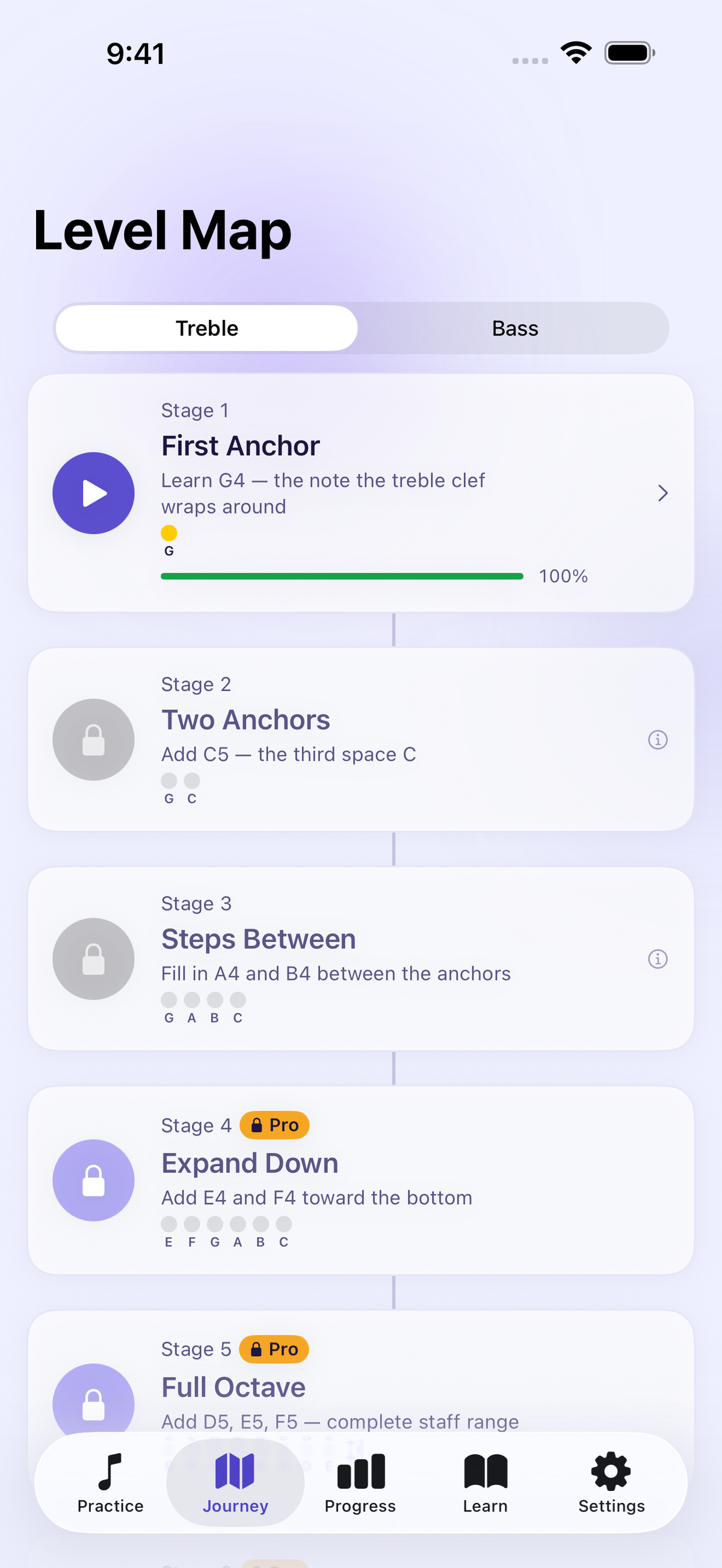
Try StaffReader (free Stages 1–3): the landmark core with the mastery gate built in, now on the App Store. Stages 4–15 and the parallel bass-clef track (anchored on F3) are the one-time $4.99 unlock.
Keep reading
- Landmark Notes vs Mnemonics: What Actually Makes You Fluent
- Why 'Every Good Boy Does Fine' Is Slowing You Down
- What Chess Masters Teach Us About Reading Music
- Accuracy Isn't Fluency: The Automaticity Gap in Note Reading
- How Long Does It Take to Learn to Read Music?
Sources: Sloboda (1974, 1977) on expert pattern reading; Chase & Simon (1973) on chunking; LaBerge & Samuels (1974) on automaticity; Bloom and Kulik et al. on mastery learning; Karpicke & Roediger (2007) on retrieval and Cepeda et al. (2006) on spacing. No single study establishes one method as definitively fastest — the comparisons above lead with mechanism and expert consensus, not claims of proof.


